
Our traffic management specialists are ready to assist you today
Freeway Traffic Control and TMA Crews in Ontario
Salus Traffic supplies certified crews, MASH compliant truck mounted attenuators and Book 7 compliant closures for work on Ontario’s 400-series highways and other high-speed corridors. Dispatched from our Concord yard, 24 hours a day.
MASHCompliant Attenuators
24/7Emergency Response
100%OTM Book 7 Compliant
OntarioProvince-Wide Coverage
Freeway Traffic Control in Ontario
Working beside traffic moving at 100 km/h is a different job from closing a curb lane on a city street.
The tapers are longer, the advance warning starts further back, the buffer between the last cone and the first worker has to be measured rather than estimated, and the vehicle protecting the crew has to be built to take a hit. Salus Traffic runs freeway and highway traffic control for contractors, utilities and public owners across Ontario, with crews who work the 400-series corridors and understand what those roads demand.
Every freeway closure we set up follows Ontario Traffic Manual Book 7, the standard that governs temporary conditions on Ontario roads. Book 7 has its own layouts and spacing for freeways because of the speeds involved, and it calls for truck mounted attenuators where crews or equipment are exposed to live freeway traffic. We plan to it, we set up to it, and our supervisors inspect against it once the closure is live.
If you are pricing a resurfacing contract, a bridge rehabilitation, a guardrail run, an overnight sweeping program or a single shoulder closure for a utility crossing, tell us where and when. We will confirm the layout, the number of attenuators and the crew you need.
Who Calls Us for Highway Traffic Control
Most of our freeway work comes from crews that need to get on and off a high-speed road safely, often at night, and usually on a schedule set by someone else. A few of the groups we support regularly:
- General contractors on MTO and municipal resurfacing, widening and rehabilitation contracts
- Bridge and structure crews working from the deck, the shoulder or the lanes below
- Utility and telecom crews crossing or running along a highway corridor
- Guardrail, lighting, ITS and sign installation contractors
- Line painting, sweeping and maintenance operations that keep moving
- Geotechnical, survey and inspection teams that need a short, clean closure
Read more about the sectors we work in on our industries page.

What Our Freeway Crews Handle
From a single shoulder closure to a full overnight detour, one crew and one point of contact.
Lane and Shoulder Closures
Single lane, multi-lane and shoulder closures on freeways and high-speed arterials. Tapers, buffer spaces and advance signing are sized to the posted speed, arrow boards are set at the taper, and a supervisor signs off the layout before the crew starts work behind it.
Ramp Closures and Detours
On-ramp and off-ramp closures with signed detours, portable message boards placed well ahead of the closure, and coordination with the road authority so the closure opens and closes on the hours you were given.
Rolling and Mobile Operations
Moving closures with shadow vehicles and attenuators for line painting, pavement marker installation, sweeping, crack sealing, debris removal and survey work. The protection moves with the operation instead of tying up a long stretch of road.
Crash Trucks and TMAs
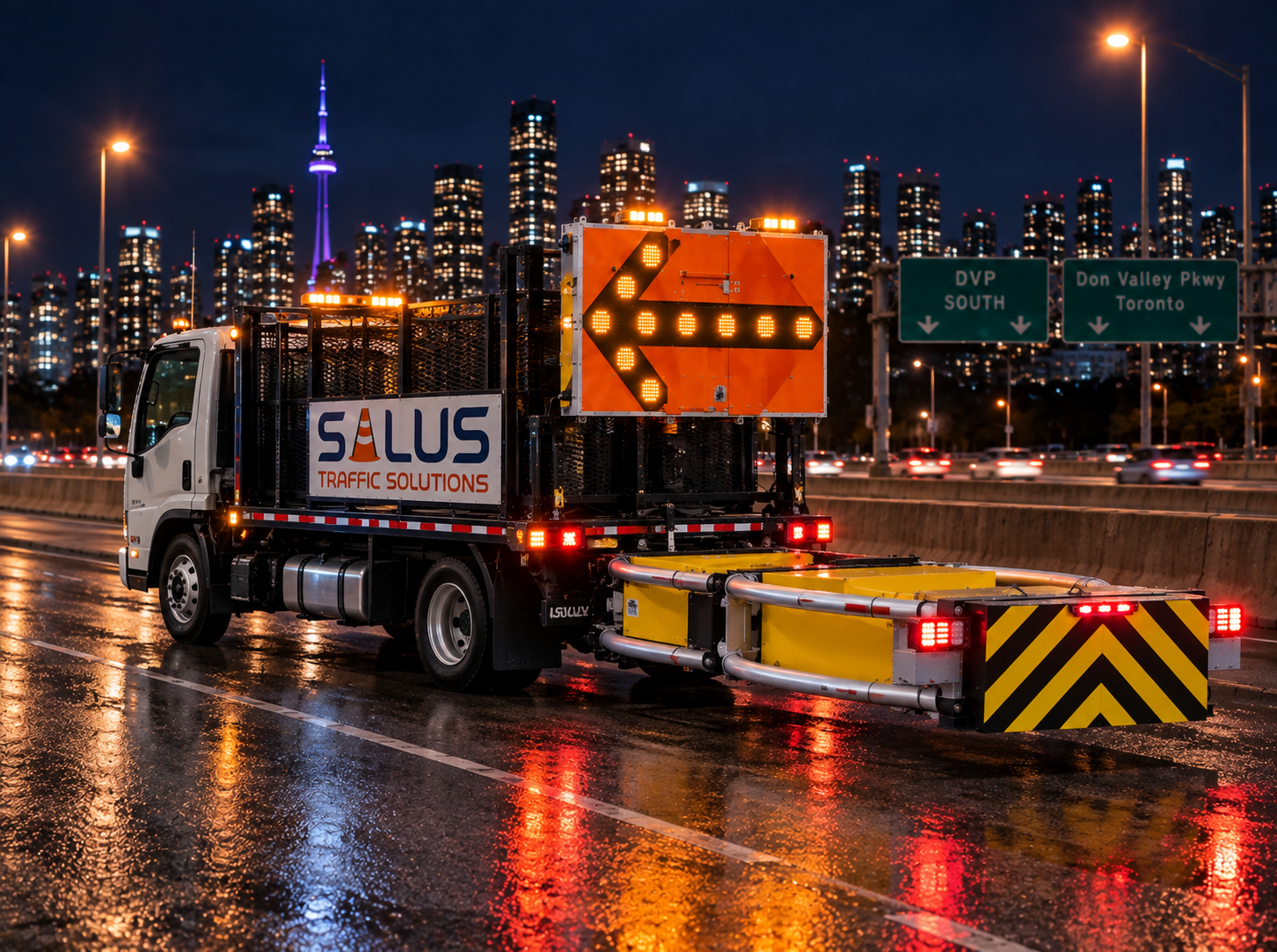
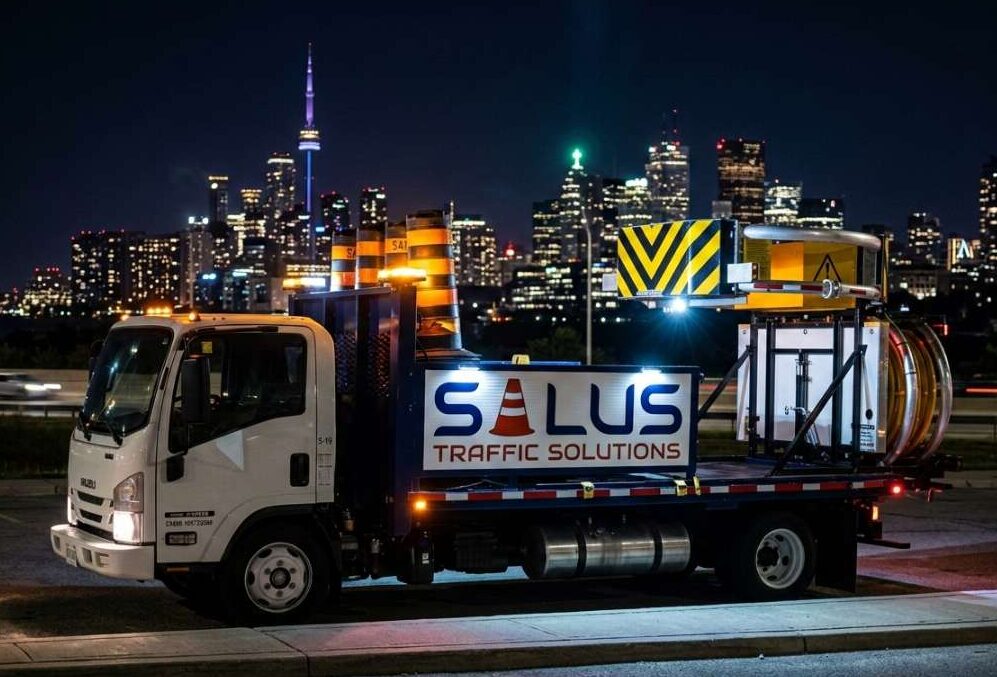
MASH compliant truck mounted attenuators with trained operators who understand roll-ahead distance, lateral offset and positioning relative to the work area. Each unit carries its own arrow board and lighting. See the fleet page for more on the equipment.
Overnight and Weekend Closures
Lane closures on the busiest corridors are restricted to off-peak hours, which is why much of this work happens between late evening and early morning. Our night crews are trained on lighting placement and low-visibility procedures and hold the same standards we apply during the day.
Emergency and Short-Notice Response
Sign knockdowns, incidents inside the work zone, weather changes and schedule moves do not wait for business hours. Our operations team runs a 24/7 response line so the closure stays compliant when conditions change.
Need a Crew on the Highway?
Send us the location, lanes affected, work type and hours. We will come back with a plan and a price.

Truck Mounted Attenuators in Ontario
A truck mounted attenuator, usually called a TMA or crash truck, is an energy-absorbing cushion fitted to the back of a heavy truck. The truck parks between live traffic and the crew. If a driver fails to notice the closure and strikes it, the attenuator crushes in a controlled way, the truck rolls forward a predictable distance, and the people working ahead of it are protected.
Salus Traffic operates crash trucks fitted with MASH compliant attenuators. MASH is the current crash-test standard for roadside safety hardware in North America, and it is the benchmark Ontario road authorities look for on high-speed work. Our operators are trained on where the truck sits relative to the work area, how much roll-ahead room it needs and how far it should be offset from the lane line, because a TMA in the wrong spot protects nobody.
When a TMA is used on a freeway
- Short-duration work in a live lane or on the shoulder of a freeway
- Mobile operations such as line painting, sweeping and pavement marker installation
- Long-duration lane closures where crews or equipment sit exposed to traffic
- Setting up and removing the closure itself, when workers are most exposed
- Any operation where the contract, the owner or the traffic control plan specifies one
TMA truck rental in Ontario
Contractors searching for a TMA truck rental in Ontario are usually in one of two situations. Either they have their own traffic control crew and need protection vehicles to shadow it, or they need the whole closure handled. Salus Traffic covers both. Our attenuator trucks come with a trained operator, and they can be booked on their own to protect your crew or as part of a full freeway closure with signs, arrow boards, message boards and traffic control persons where the layout calls for them. Tell us the scope and we will confirm what fits. Cones, barrels, signs and boards for your own crews are covered on our equipment rentals and sales page.
How a Freeway Closure Comes Together
Highway work runs on tight windows. This is how we make sure the closure is ready when yours opens.
Scope and Plan
We review the location, posted speed, lanes affected, work type and hours. If you need a traffic control plan for permit submission, our plans and project support team prepares a Book 7 compliant layout for the site.
Mobilize from Concord
Crew, crash trucks, arrow boards, message boards and signage are staged and inspected at our yard, then dispatched to arrive ahead of your closure window.
Set Up and Hold
The closure goes in from the advance signs forward. A supervisor inspects tapers, buffer spaces and attenuator positioning against the plan, and the crew maintains the layout for the duration of the shift.
Open and Report
Devices come out in the correct order, the road is returned to normal operation on time, and you get the documentation the owner or inspector expects.
Areas Served
Crews and equipment are dispatched from 329 Rayette Rd in Concord, close to the Highway 400 and 407 corridors, and we serve freeway projects across Ontario.
Freeway and Expressway Corridors
Provincial highways fall under MTO permit requirements. The Gardiner Expressway and Don Valley Parkway are City of Toronto roads with their own permit process, and Highway 407 has requirements set by its operator. We work to whichever applies. We also cover rural provincial highways and regional roads with high posted speeds, where Book 7 calls for similar spacing and protection.
Regions We Cover
- Toronto
- Vaughan, Concord and York Region
- Mississauga, Brampton and Peel Region
- Pickering, Ajax, Whitby, Oshawa and Durham Region
- Oakville, Burlington, Milton and Halton Region
- Hamilton and Niagara Region
- Barrie and Simcoe County
- Kitchener, Waterloo, Cambridge and Guelph
- London and Southwestern Ontario
- Eastern and Northern Ontario on a project basis
Why Contractors Choose Salus Traffic for Highway Work
Freeway closures leave no room for a crew that is learning on the job. Here is what you get when Salus Traffic is on the contract.
- Crews certified to OTM Book 7, with supervisors who inspect every closure
- MASH compliant attenuators, arrow boards and signage from our own fleet
- Traffic control plans prepared in house and ready for permit submission
- One accountable partner from the plan through to demobilization
- Night, weekend and 24/7 emergency coverage
- Safety program and documentation ready for contractor prequalification
Our approach to training, inspections and documentation is covered on the safety and compliance page, and you can read about recent work on our project experience page.
Related Services
Traffic Management Operations
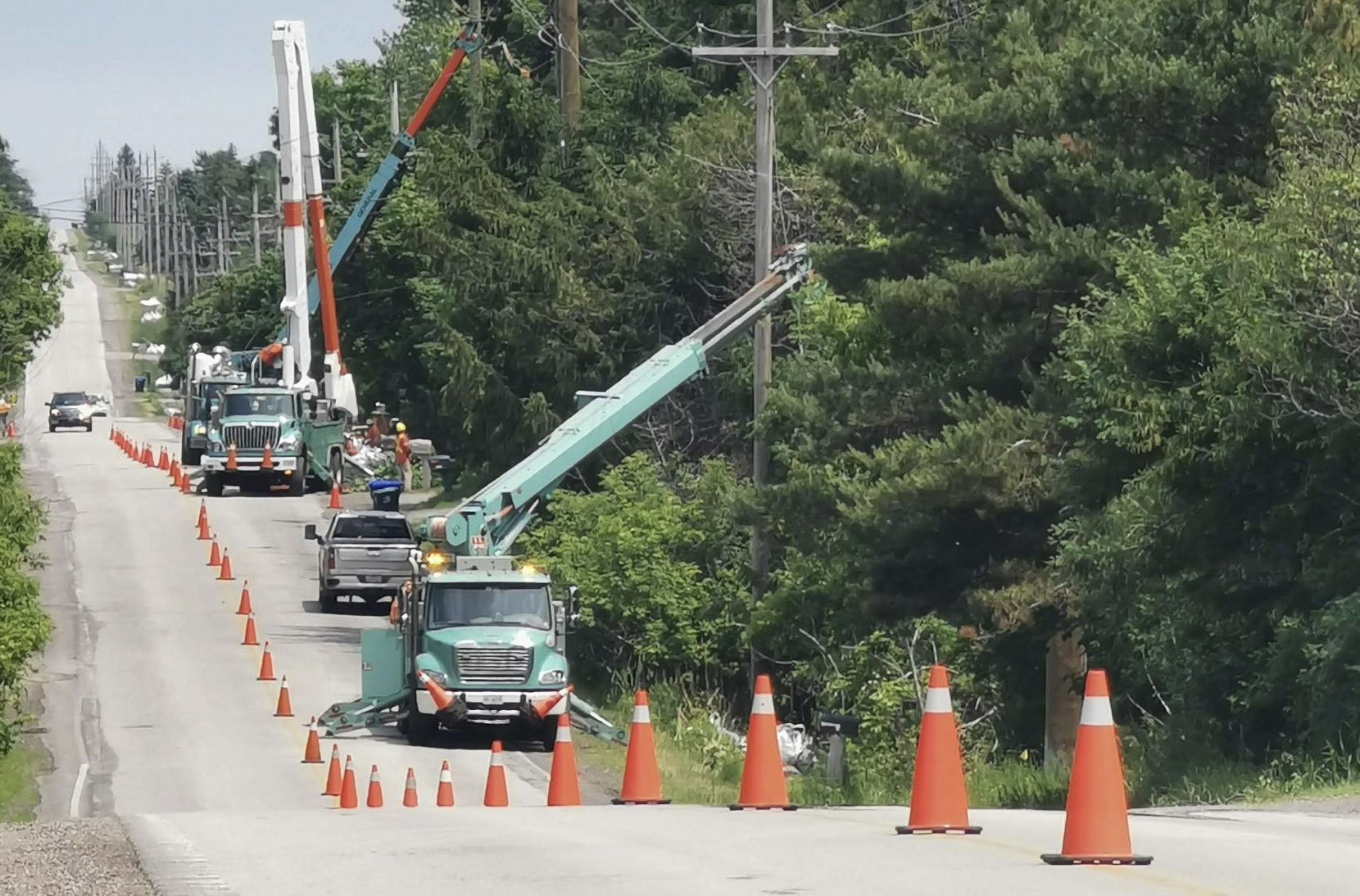
Lane closures, flagging crews, night operations and pedestrian management for urban and arterial roads across Toronto and Ontario.
Traffic Plans and Project Support
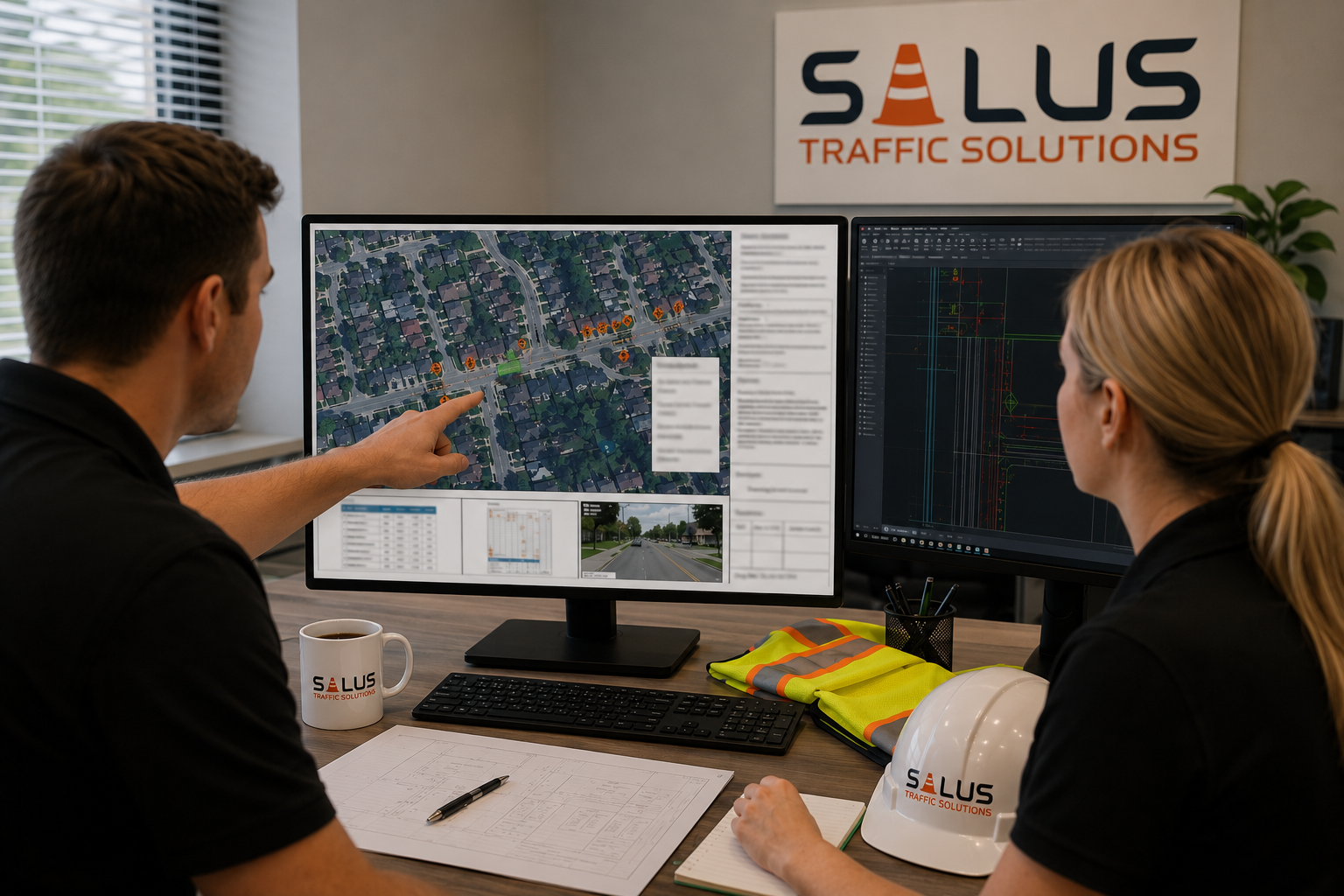
Book 7 compliant traffic control plans, permit support and engineering coordination for freeway and municipal projects.
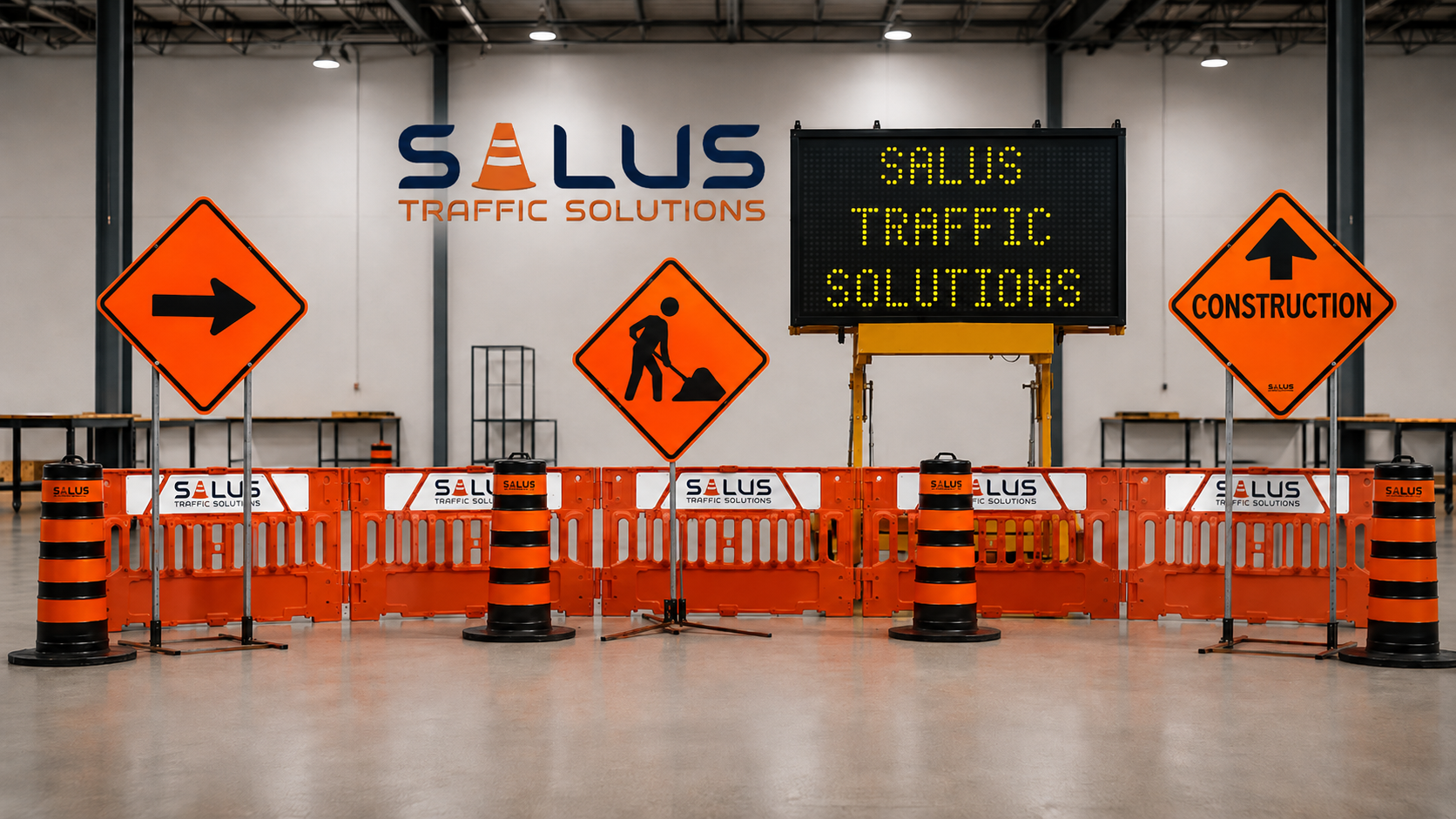
Equipment Rentals and Sales
Cones, barrels, signs, arrow boards and message boards for contractors who run their own crews.
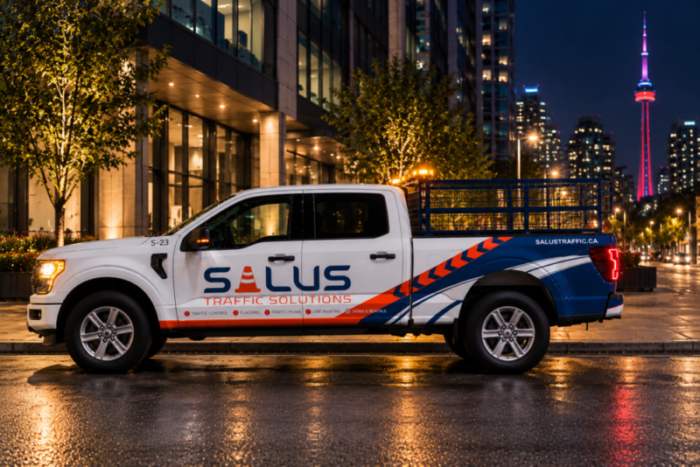
Fleet and Assets
Crash trucks, traffic control vehicles, line striping trucks, arrow boards and message boards maintained for Ontario projects.
Freeway Traffic Control FAQs
Common questions from contractors planning highway work in Ontario.
What makes freeway traffic control different from regular road traffic control?
Speed. On a road posted at 100 km/h, drivers cover a lot of ground in the time it takes to react, so Book 7 requires longer tapers, larger buffer spaces and advance warning signs placed much further from the work. Truck mounted attenuators become a standard part of the setup, and flagging is generally replaced by lane closures, arrow boards and detours. Crews also need to be comfortable working at night, since that is when most freeway lane closures are permitted.
What is a truck mounted attenuator and when is one required in Ontario?
A truck mounted attenuator is a crash cushion mounted to the rear of a heavy truck that is parked between live traffic and the work crew. Ontario Traffic Manual Book 7 calls for them on freeway work where workers or equipment are exposed to traffic, including short-duration and mobile operations, and they are specified on most long-duration freeway closures as well. Many contracts and traffic control plans spell out exactly when a TMA has to be present.
Can I rent a TMA truck in Ontario without a full traffic control crew?
Yes. Our attenuator trucks are supplied with a trained operator and can be booked to shadow your own crew, or as part of a complete closure package with signs, arrow boards and message boards. Send us the location, dates and type of work through the contact page and we will confirm the setup and pricing.
Are your truck mounted attenuators MASH compliant?
Yes. Salus Traffic operates crash trucks fitted with MASH compliant attenuators. MASH, the Manual for Assessing Safety Hardware, is the crash-test standard that replaced the older NCHRP 350 criteria, and it is the standard Ontario road authorities expect on high-speed work zones.
Do you provide traffic control on 400-series highways at night?
Yes. Most freeway lane closures in Ontario are limited to overnight hours to keep daytime traffic moving, so night work is a normal part of our schedule. We staff dedicated night crews, plan lighting placement into the setup and hold the same inspection standards after dark as we do during the day.
Who prepares the traffic control plan and handles permits for freeway work?
We can. Our traffic plans and project support team prepares Book 7 compliant traffic control plans that are ready for submission to MTO, the City of Toronto or the municipality that owns the road. If you already have an approved plan, we will build the closure to it. Details are on the traffic plans and project support page.
How quickly can a crew get to my site?
Crews and equipment are dispatched from our yard in Concord, which puts the entire Greater Toronto Area within easy reach and gives us direct access to the Highway 400 and 407 corridors. We run a 24/7 emergency response line for urgent situations. For planned work, the earlier we have your closure windows, the easier it is to hold the crew and equipment you need.
What information should I include when requesting a quote?
The highway and location, which lanes or ramps are affected, whether the work is stationary or moving, the dates and hours of each closure, the expected duration of the project, and whether an approved traffic control plan already exists. If you have a contract clause or owner specification covering traffic control, send that too. With those details we can price the job accurately the first time.
Ready to Plan Your Freeway Closure?
Tell us where the work is, what lanes are affected and when your window opens. Our team will come back with a compliant layout, the right number of attenuators and a clear price.


