
Our traffic management specialists are ready to assist you today
Road Occupancy and Street Occupation Permits in Toronto
Toronto issues Street Occupation Permits through Transportation Services, and every lane, sidewalk or boulevard closure also needs a RoDARS application before the work starts. Salus Traffic prepares the Book 7 traffic management plan, assembles the package and files it for you, then supplies the crew that runs the closure.
5 to 10Working Days for RoDARS
100%OTM Book 7 Compliant Plans
4GTA Road Authorities Covered
24/7Emergency Response
Who Issues Road Occupancy Permits in Toronto
Short answer: the City of Toronto, through Transportation Services, and usually in two steps.
If your project puts anything on a Toronto street, sidewalk, laneway or boulevard, from a disposal bin to a crane to a six-month lane closure, you need a Street Occupation Permit from Transportation Services. The permit covers the occupation itself. Separately, any work that affects how vehicles, cyclists or pedestrians move through the right-of-way has to be filed in the Road Disruption Activity Reporting System, known as RoDARS, so the City can coordinate closures across the network and post them on its road restriction map.
The order matters. The City permit comes first. RoDARS is filed once the permit exists, with the permit attached, and the closure cannot start until the RoDARS application is approved and the City’s QR code sign is posted in the work zone. Longer closures for building projects, called construction staging areas, go further still: on a major arterial road they have to be approved by City Council.
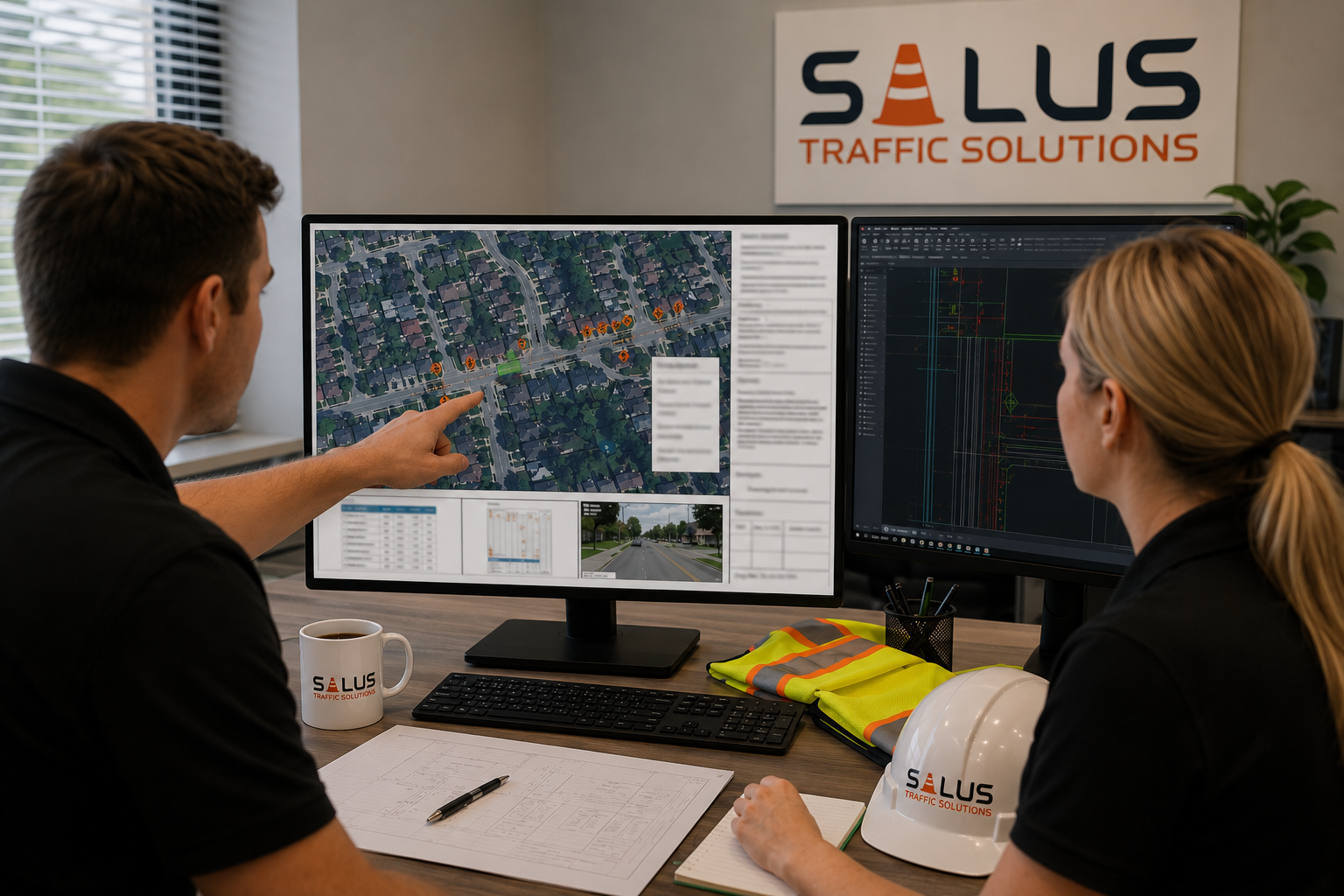
The City publishes its own guidance on the Street Occupation Permit page and the RoDARS page, and you can apply yourself. Most contractors we work with would rather hand it off. Our plans team prepares the traffic management plan, the drawings and the closure letter the City asks for, files the RoDARS application on the right form, and answers the coordinator’s questions until the approval comes through.
Toronto Traffic Permits at a Glance
The permits and approvals that come up on construction, utility and development work in the City of Toronto.
| Permit or approval | Issued by | When you need it | Typical lead time |
|---|---|---|---|
| Street Occupation Permit | City of Toronto, Transportation Services | Any time equipment, materials, a bin, hoarding, scaffolding, a crane or a lane closure occupies the road, sidewalk or boulevard during demolition, renovation or construction | Not published by the City. Allow several weeks for routine occupations. Tower crane applications take about 12 weeks once the package is complete |
| RoDARS application | City of Toronto, Transportation Services, filed online | Every occupation of the public right-of-way that affects traffic, cyclists or pedestrians, including the Gardiner, DVP and Allen Road. Filed after the underlying permit is issued | At least 5 working days for occupations of 1 to 10 days. At least 10 working days for longer occupations, full lane closures and expressways |
| Construction staging area | Transportation Services, with City Council approval on major arterial roads | A long-term closure of a lane or sidewalk for a building project, usually with hoarding and a covered walkway, lasting months or years | Months. The request is written up as a staff report and goes to Community Council and then City Council on their meeting calendar |
| Utility cut or non-utility cut permit | City of Toronto, Transportation Services | Any time you cut into the pavement, sidewalk or boulevard, for a service connection, a repair or new infrastructure | Apply early. The permit has to exist before the RoDARS application can be filed |
| Street event closure permit | City of Toronto | Road races, parades, festivals and other events that close a street. RoDARS is not currently required for street events | Varies by event size. See our special event traffic control information |
Lead times are the City’s published minimums or our reading of its process, not guarantees. Applications received after 5 p.m. or on a non-working day count as received the next working day.
Toronto’s Permit Types in Plain Language
Three names come up on almost every Toronto job. Here is what each one actually does.
Street Occupation Permit
The permit to physically use part of the street. The City’s list of triggers is long: disposal bins in the roadway or a laneway, stored materials and trailers, scaffolds and hoarding, covered walkways, cherry pickers and forklifts, mobile and tower cranes, concrete pumping, swing stages, even a temporary asphalt ramp into the site. Fees are charged per day for equipment and lane closures, per square metre per month for roadway and boulevard space, and per lineal metre for hoarding, with roadway rates set by zone and highest in the downtown core.
RoDARS
The Road Disruption Activity Reporting System is how the City coordinates every closure in the network. It is not a permit on its own. It is the notification and booking step that sits on top of your permit, and nothing closes until it is approved. The form depends on who you are: Form 1SOP for work under a Street Occupation Permit, Form 2 for developer-led projects, Form 1 for approved utilities and Form 3 for agencies and other organizations. Approval arrives by email with a QR code sign that has to be posted in the work zone.
Construction Staging Area
When a building project needs a lane or sidewalk for the life of the job, the City treats it as a construction staging area. The request is written up by Transportation Services as a staff report, and on a major arterial road City Council has to approve it. Conditions typically include a covered, accessible pedestrian walkway, daily sweeping, enhanced lighting, a 24-hour hotline posted on the hoarding, traffic control persons and pay-duty police for hoisting and large pours, consultation with local BIAs, and bike lane accommodation.
What a Toronto Submission Needs
The City’s reviewers work from a checklist, and an application that is missing one item goes to the back of the queue. This is what a complete Street Occupation Permit and RoDARS package looks like for a typical lane closure.
- The completed Street Occupation Permit application, paid for when the permit is issued
- A construction traffic management plan prepared to Ontario Traffic Manual Book 7, which the City requires for applications and directives
- Drawings to scale, in metric, with the scale noted, a north arrow, street and property lines, dimensions, and every feature in the area: trees, poles, hydrants, meters, bus shelters, Green P and car share spaces
- A closure letter for any street, sidewalk or lane closure, describing how the right-of-way will be used, how long, and the proposed work schedule
- A certificate of insurance naming the City of Toronto as an additional insured, with a cross-liability clause, where the permit type calls for it
- For cranes, stamped engineering drawings for the base and counterweight, the boom swing radius, and written approval from Transport Canada and Nav Canada
- A Metrolinx Corridor Development Permit or No Conflict letter if the site falls inside a Metrolinx review zone, which covers a large part of the city along the transit corridors
- The RoDARS application, filed on the correct form once the permit exists, with the permit attached
Our traffic plans and project support team produces every drawing in this list except the stamped crane engineering, and we coordinate with your engineer on that.
How Long Toronto Permits Take
RoDARS has published minimums: five working days before the closure for occupations of one to ten days, and ten working days for anything longer, any full lane closure, and any work on the Gardiner Expressway, the Don Valley Parkway or Allen Road between Eglinton and Transit Road. The City offers an expedited review for an extra fee but does not guarantee it.
The Street Occupation Permit itself has no published processing time for ordinary occupations. In practice, build in several weeks between a complete submission and a permit in hand, and twelve weeks for a tower crane. Construction staging areas on major arterials take months, because the approval has to pass through Community Council and City Council.
Timing also depends on when you want the lanes. The City’s expressways cannot be occupied during weekday peaks. A shoulder closure is kept out of 7 to 9 a.m. and 3 to 9 p.m. A lane closure that leaves two or more lanes open is kept out of 5 a.m. to 11 p.m., and one that leaves a single lane open is kept out of 5 a.m. to 2 a.m. the next day, which means overnight only. On arterial roads the reviewer will often push daytime closures on busy streets into overnight or off-peak windows. Ask for peak-hour lanes on King, Queen or Bloor and expect a conversation.
Why Submissions Get Sent Back
The same problems hold up Toronto applications over and over. Avoid these and the review goes faster.
- RoDARS filed before the underlying permit exists, or without the permit attached
- A traffic control plan that is not to Book 7, or a drawing with no scale, no north arrow or no dimensions
- A closure letter that leaves out the duration or the work schedule
- A pedestrian route that is not covered, lit, cane-detectable and accessible
- A bike lane closed with no accommodation shown for cyclists
- Peak-hour lane closures requested on an arterial road or an expressway
- A site inside a Metrolinx review zone with no Corridor Development Permit or No Conflict letter
- An insurance certificate that does not name the City or lacks the cross-liability clause
- A submission filed after 5 p.m. or inside the minimum lead time
- TTC routes and stops affected with no plan for maintaining service
We Prepare the Plan and File It for You
Send us the address, the work and the dates. We will tell you which permits apply, draw the plan and handle the submission.
Let Salus Traffic Handle the Permit
Permit searchers usually want the City’s page. We linked to it above. What most of them need is someone to do the work.
A permit package is only as good as the plan inside it, and the plan is only as good as the crew that builds the closure to it. Salus Traffic does both, which is why contractors hand us the whole job rather than splitting it between a drafting service and a traffic company that has never seen the drawing.
- Site review to confirm the road authority, the permit types and the closure windows that will be allowed
- Book 7 traffic management plan and scaled drawings in the City’s required format
- Closure letter, work schedule and the supporting documents the reviewer expects
- RoDARS application on the correct form, with the permit attached and the revision filed if dates change
- Responses to coordinator comments until the approval and the QR code sign are issued
- Certified crews, signs, barricades and arrow boards to build and maintain the closure as drawn
For projects on provincial highways, the permit sits with MTO and the rules change. That work is covered on our freeway traffic control page.
Road Occupancy Permits in Peel, York and Durham
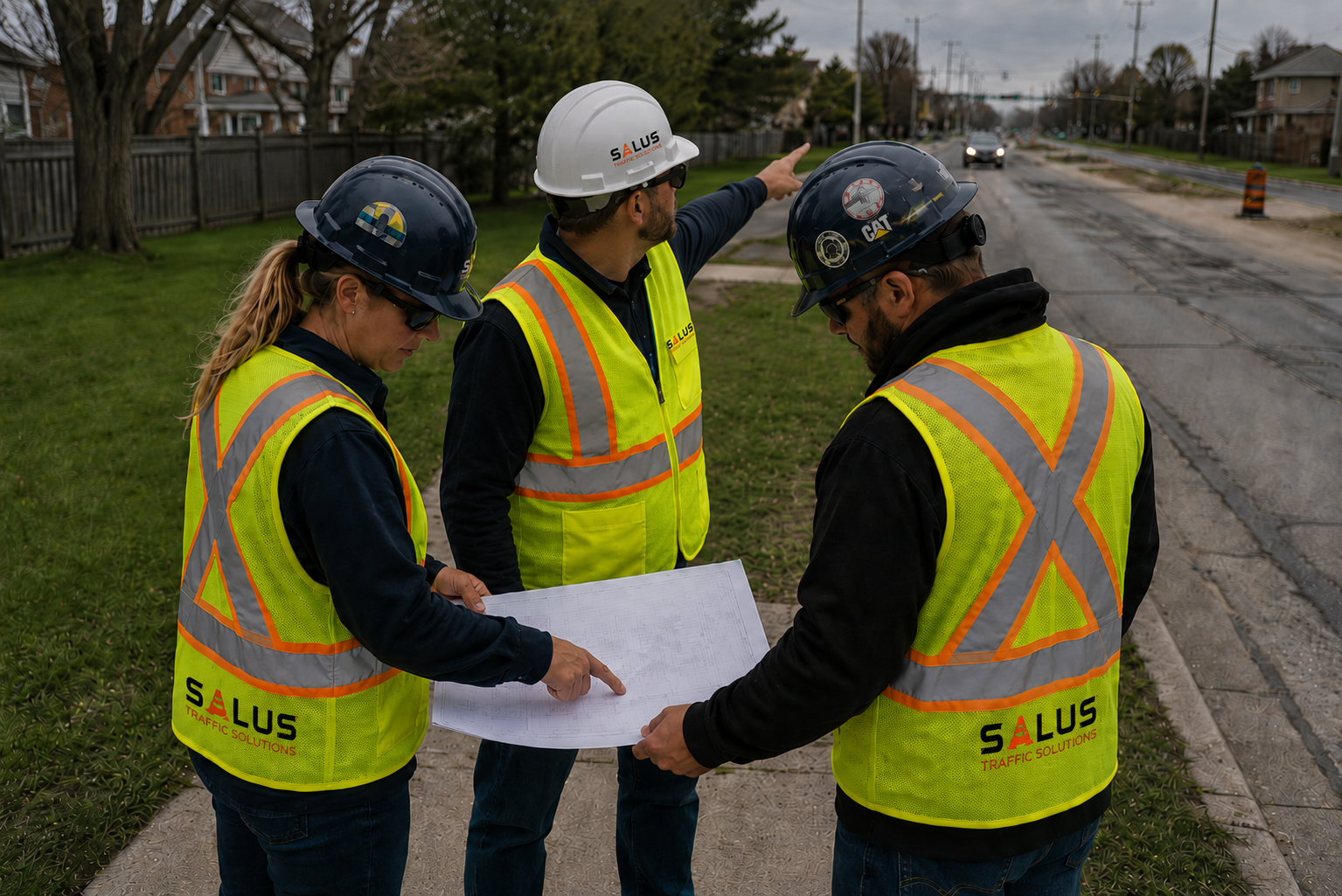
Outside Toronto, the regions issue permits for Regional roads and each city or town handles its own streets. The names change, the Book 7 plan does not.
Peel Region
Peel Region requires a Road Occupancy Permit for any work on Regional roads such as Hurontario Street, Dixie Road, Derry Road, Mayfield Road and Airport Road. The package goes to Road Permits by email, mail or in person at 10 Peel Centre Drive and must include the application, a traffic control plan designed to OTM Book 7, a detailed drawing of the work within the right-of-way, and a certificate of insurance naming the Region with a minimum of $5 million commercial general liability. The City of Mississauga and the City of Brampton issue their own road occupancy permits for city streets.
York Region
York Region issues a Corridor Control Permit for Road Occupancy for Regional roads, including Highway 7, Yonge Street, Major Mackenzie, Rutherford, Keele and Jane, through its online portal, and asks for applications about four weeks before the start date with a Book 7 traffic management plan, insurance and a 24-hour contact. Lane closures in weekday peak periods need separate approval. Vaughan, Markham, Richmond Hill and the other local municipalities handle their own streets. The full breakdown is on our Vaughan and York Region page.
Durham Region
Durham Region accepts Road Occupancy Permit applications for Regional roads through an online permit application and asks for five business days to process them. Regional roads in Durham include Taunton Road, Brock Road, Simcoe Street, Thickson Road and Bayly Street. Pickering, Ajax, Whitby, Oshawa and Clarington each issue permits for their own roads. Our crews cover all of Durham from the Concord yard.
Regional requirements change, so confirm the current forms and fees on each authority’s site before you file: Peel Region, York Region and Durham Region.
Areas We Serve
Permit preparation for any road authority in the Greater Toronto Area, with crews dispatched from our yard at 329 Rayette Rd in Concord.
City of Toronto
Toronto designates Construction Hubs in areas where building activity is concentrated, and long-term permit fees inside a hub are 25 percent higher than the standard rate. If your site is in one, the plan has to account for the coordination the City expects there.
Peel, York and Durham
- Mississauga
- Brampton
- Caledon
- Vaughan, Concord and Woodbridge
- Richmond Hill and Markham
- Aurora and Newmarket
- Pickering and Ajax
- Whitby and Oshawa
- Clarington
Work in Vaughan or elsewhere in York Region is covered in detail on our Vaughan and York Region page. For province-wide coverage, see traffic management operations.
Toronto Permit FAQs
The questions contractors ask us most often about Toronto street occupation and lane closure permits.
How do I get a lane closure permit in Toronto?
There is no single document called a lane closure permit. A lane closure in Toronto is covered by a Street Occupation Permit from Transportation Services, which authorizes the occupation and charges a daily lane closure fee, followed by a RoDARS application that books the closure in the City’s system. Both have to be in place before the first barrel goes down, and the RoDARS approval comes with a QR code sign that must be posted at the work zone.
What is the difference between a street occupation permit and RoDARS?
The Street Occupation Permit is the City’s permission to occupy the street, sidewalk or boulevard, and it carries the fees. RoDARS is the coordination system that schedules the closure across the whole road network so the City can manage conflicts and publish restrictions. You need the permit first and the RoDARS approval second. Filing RoDARS without the permit is one of the most common reasons an application is returned.
How much notice does the City of Toronto need?
For RoDARS, at least five working days before the closure for an occupation of one to ten days, and at least ten working days for occupations longer than ten days, any full lane closure, and any work on the Gardiner, the DVP or Allen Road. Applications are due by 5 p.m. The Street Occupation Permit has no published timeline, so allow several weeks, and about twelve weeks for a tower crane. Construction staging areas on major arterials are measured in months because they go to City Council.
What is a construction staging permit in Toronto?
A construction staging area is a long-term occupation of a lane, sidewalk or both for a building project, usually with hoarding and a covered pedestrian walkway. Transportation Services writes the request up as a staff report with conditions, and when the site is on a major arterial road City Council approves it. Fees are based on the area occupied and the duration, and the City adds a Traffic Management Recovery Fee for the lane closure through RoDARS.
Do I need a traffic control plan for a Toronto street occupation permit?
Yes. The City requires construction traffic management plans for applications and directives, and the plan has to follow Ontario Traffic Manual Book 7. The drawing has to be to scale, in metric, with a north arrow and the surrounding features shown. Our plans team prepares these for Toronto submissions, and the same plan guides the crew that builds the closure.
Can I close a lane on the Gardiner Expressway or the DVP?
Yes, within the City’s expressway guidelines. Closures on the Gardiner, the Don Valley Parkway and Allen Road need a RoDARS application at least ten working days ahead and are kept out of peak periods. On a weekday, a shoulder closure is not allowed between 7 and 9 a.m. or 3 and 9 p.m. A lane closure that leaves two or more lanes open is not allowed between 5 a.m. and 11 p.m., and one that leaves a single lane open is not allowed between 5 a.m. and 2 a.m., so lane closures are overnight work. Full closures in one direction are generally not permitted. The City can approve or deny any request and may allow long-term closures in restricted hours. Crash trucks with truck mounted attenuators are standard on this work; see our freeway traffic control page.
What is a Toronto Construction Hub and why does it matter?
Construction Hubs are districts the City has designated where several large projects are under way at once. Long-term street occupation permits inside a hub cost 25 percent more than the standard fee, and the City coordinates closures in those areas more closely. Hub boundaries are set out in Toronto Municipal Code Chapter 743. If your site is inside one, we plan the closure with that coordination in mind from the start.
What if my site is near a Metrolinx transit project?
Toronto requires right-of-way permit requests to be checked against the Metrolinx Third Party Coordination and Permitting Map. If your site is in a Metrolinx review zone or along a corridor, you need a Corridor Development Permit or a No Conflict Response Letter from Metrolinx before RoDARS will approve the closure, and the Metrolinx submission asks for the scope of work, civil plans, the construction window and the traffic control plan. We prepare the traffic control component and flag the Metrolinx step early so it does not stall the permit.
Do you handle permits outside Toronto?
Yes. We prepare Book 7 traffic control plans and permit packages for York Region, Peel Region, Durham Region and the cities and towns inside them, and for MTO work on provincial highways. The forms and fees differ, but every one of them asks for the same thing at the centre: a traffic control plan that a reviewer can approve and a crew can build.
Need a Toronto Permit Filed This Week?
Send us the address, the work and the dates. We will confirm which permits apply, prepare the traffic management plan and drawings, file the application and put a certified crew on the closure when it is approved.


